Showing posts with label Creeds. Show all posts

Friday, November 11, 2011

Austin Farrer, Radical Centrist

Austin Farrer (1904–1968) was one of the most brilliant and original British theologians of the previous century. Rowan Williams, the current Archbishop of Canterbury, has described Farrer as “possibly the greatest Anglican mind of the twentieth century.” He was a friend of J.R.R. Tolkien, Dorothy Sayers, and C. S. Lewis. Farrer took the last sacraments to Lewis before his death and preached at his funeral. He wrote scholarly books on theology, but also more popular and devotional books. His collections of sermons are edifying. He should be more widely read than he is. He is another theologian who cannot be easily identified as either "conservative" or "liberal" but undeniably centered in Jesus Christ.

The following is from a wonderful little book of reflection on the Apostles' Creed, Lord I Believe: Suggestions for Turning the Creed into Prayer:

Though God be in me, yet without the creed to guide me, I should know neither how to call upon God, nor on what God to call. God may be the very sap of my growth and substance of my action; but the tree has grown so crooked and is so deformed and cankered in its parts, that I should be at a loss to distinguish the divine power among the misuse of power given. Were I to worship God as the principle of my life, I should merely worship myself under another name with all my good and evil. Lord I Believe, p. 14

Friday, September 9, 2011

Creedal Minimalism

No reference is made to the Devil or devils is included in any Christian Creeds, and it is quite possible to be a Christian without believing in them. I do believe such things exist, but that is my own affair. C. S. Lewis, Answers to Questions on Christianity in God in the Dock, p. 56

Radical Centrist Manifesto IX. Centered in the Body of Christ,
Part 2: Centered in the Creed, iii


Given what has come before in this series, it should be clear that I take being centered in the Creeds to be essential. I am wary of those who would replace the Creed with their own “vague, indefinite religious apprehensions” or their own not-so-vague religious apprehensions. I agree with the great Anglican bishop, Charles Gore (1852-1932), that we should be “conspicuously orthodox on the great fundamentals of the Trinity and the Incarnation” and “accept the ecumenical councils as criteria of heresy" (Roman Catholic Claims).

But, I am also wary of over-definition beyond that. If the Creed is the fundamental and central summary of the faith, then other things are less fundamental and less central. I am suspicious of the tendency among some to elevate almost their every conviction and pious opinion to “creedal” status. We want to avoid an "unrestrained development of the individual judgment which becomes eccentric and lawless just because it is unrestrained." But we should also avoid "a dogmatism that crushes instead of quickening the reason of the individual, making it purely passive and acquiescent." (Gore, Roman Catholic Claims).

In fact, I am something of a creedal minimalist.

One cannot reduce Christian faithfulness to just believing and living the Creed with integrity. Gore also said, “There are, indeed, features in the common faith, such as the belief in atonement, in sacramental grace, in the inspiration of Scripture, which are only slightly or by implication touched on in these formulas of faith; but at least in what they contain they represent what has been universal Christianity” (The Permanent Creed and the Christian Idea of Sin). Still, it becomes problematic when we try to make one or another understanding of atonement or sacramental grace or inspiration of scripture, etc., definitive. The Church of the ecumenical councils did not presume to define such things with exactness and neither should we. Which is not the same thing as saying they do not matter.

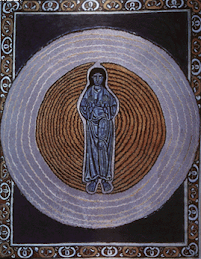
The Creedal outline is at the center. Other Church teaching and discipline radiate out from that center in concentric circles of importance. We will have disagreements about how near the center this or that might be. But, let us debate with passionate patience and humility, taking into account that we all only see as though through a glass darkly.

This does not mean that all disagreements are equal or that all beliefs on matters beyond the Creed are acceptable. I am not shy about weighing in on such things and others. Still, questions, new interpretations of scripture or tradition, and proposed rethinking of various matters of faith will arise among the Church's members. More than we like to believe, much of our interpretations of scripture and tradition can only be provisional. This side of the kingdom they will be incompletely understood, let alone lived. It is part of the Church's vocation in every generation to wrestle reasonably, in the light of scripture and tradition, with whatever questions arise and discern the range of faithful disagreement.

The church - every church - has always had to balance unity and plurality. Perhaps it goes back to a more basic challenge to be both catholic and one while also seeking to be apostolic and holy. In any event, any community has to find its balance while seeking to honor each. While easy appeals to diversity and inclusivity can be cheap and even deceptive, it is also true that the Anglican tradition has typically chosen to error, if it does, on the side of plurality. It is one of the things I find appealing - if sometimes frustrating as well - about the Anglican way.

On any number of issues, I would love to have all Christians (or all Anglicans, or all Episcopalians, or all members of St. Barnabas) agree with my conclusions about what is and is not most faithful. I am inclined for example to agree with Lewis in the quote above. But, as a radical centrist, I am willing to live, even if uncomfortably, with considerable disagreement – and disagreement is inevitable – even on things that I think are fairly near the center as long the disagreement is anchored in the Creed and an honest engagement with scripture and tradition.

No doubt there are problems with such an approach (and I would truly appreciate folk pointing them out). It makes for less clarity and means that fewer things are settled. But the history of division in the body of Christ is also problematic and compromises our witness to the gospel as much as any lack of clarity on theological and moral particulars does.

The great Anglican bishop, Jeremy Taylor (1613-1667) – one who saw the devastation over-certainty and over-definition can do to the church and its witness to the gospel of Jesus Christ – wrote a treatise, (Discourse of the Liberty of Prophesying) in which he pointed out the difficulty of perfect consensus on interpretation of scripture and tradition and argued for the legitimacy of any church that subscribed to the Creed. He was arguing for such liberty within the context of what should be allowed to be legal within the boundaries of the state rather than within the particular body of the Church of England. But, I think it is consistent with the Anglican tradition to expect a basic creedal fidelity while allowing considerable liberty beyond that.

Previous - Next

Friday, August 26, 2011

The Least Silly Thing One Can Say (about God)

Rowan Williams answering "Can Finite Human Beings Say True Things About an Infinite God?"

Radical Centrist Manifesto VIII
III. Centered in the Body of Christ,
Part 2: Centered in the Creed, iv


Previous - Next

Friday, July 15, 2011

F. D. Maurice on the Creed

“All superstition, all priestcraft, in its worst and most evil sense -- we cannot repeat this proposition too often, or put it in too many shapes -- has its root in vague, indefinite religious apprehensions; not resting upon the knowledge and confession of a Being who is not our image, but who has declared Himself to us that we might receive His image”

Radical Centrist Manifesto VIII
III. Centered in the Body of Christ,
Part 2: Centered in the Creed, ii


Frederick Denison Maurice (1805-1872) was one of the great (some have argued he was the greatest) Anglican theologians of the 19th century. Maurice (pronounced like Morris) critiqued the usual church factions of his day and was seen as suspect by each of them as a result. He was hardly a conservative. He was accused of being a universalist. He was an early proponent of "Christian Socialism" which also made him suspect to both "unsocial Christians" and "unChristian socialists."

But he was also critical of liberal theology: “Every hope I had for human culture, for the reconciliation of opposing schools, for blessings to mankind, was based on theology. What sympathy then could I have with the Liberal Party, which was emphatically anti-theological, which was ready to tolerate all opinion in theology only because people could know nothing about it?"

In our own era of church factionalism, I appreciate Maurice's ability cut across party lines to engage appreciatively and critically with just about everyone. One might say he was something of a radical centrist.

The following is from a sermon of Maurice's on the significance of the Creed:

Let us understand this well, brethren, for it is very important in reference to notions that are current in the present day. If there is to be a religion of trust, and not of slavish cowardly fear, that religion must have a Revelation, the revelation of a Name for its basis. A religion which creates its own object cannot be one of trust. I cannot rest upon that which I feel and know that I have made for myself. I cannot trust in that which I look upon as a form of my own mind or a projection from it. . . Neither can I trust in any shadowy, impalpable essence, or in any Soul of the world. If this be the God I worship, my worship will be one of doubt and distrust, whenever it is at all sincere. If I do not seek all strange, monstrous means of propitiating the unknown Being, it is only because I am altogether uncertain whether he is real enough for such services. . . All superstition, all priestcraft, in its worst and most evil sense -- we cannot repeat this proposition too often, or put it in too many shapes -- has its root in vague, indefinite religious apprehensions; not resting upon the knowledge and confession of a Being who is not our image, but who has declared Himself to us that we might receive His image . . .

But the question -- How is He a Father, how do I know He is? cannot be evaded. The Church had no wish to evade it. She acknowledged that something more was implied in the Revelation of a Father than His Name; that there must be some one to reveal Him. She proclaimed the Name of His only-begotten Son, our Lord. She says that He revealed Himself as he Son of God by being conceived of the Holy Ghost our Lord, by being born of the Virgin Mary, by suffering our death, our burial, by going down into the Hell we tremble to think of; by facing all our enemies visible and invisible, all that we actually know we must meet, all that our imagination dreams of; that He rose again from the dead, and ascended into heaven, and sat down on the right of the Father, and will come again to judge the quick and the dead.

If God be absolute, eternal love, as St, Augustine makes the Catechist affirm, how has he shewn it? Has it come forth, or is it all hidden in his own nature? Has it come forth to some other creature, or to man? Has it met him where he needs to be met or somewhere else? Has it encountered the actual woes of mankind, or only those which affect a particular set of men? Has it been found mightier than these, or has it sunk under them? Has this love been cheerfully entertained, or did it encounter ingratitude? Was the ingratitude too strong for the love, or the love for the ingratitude? Is the victory for all times, or only for that time? Is He who you say is our Lord really our Lord? Does He reign over us? Will he leave all things just as they are, or set them right at last? These questions have a claim to be answered; that is no Gospel to humanity which does not answer them; the Christian Church said, 'This is the answer' . . . And again, supposing the words be true, all we have to do is to proclaim them and live upon them. He who has sent us into the world for that end can prove them. Those that know His Name will trust in Him, and so they find that He has not deceived them.

Previous - Next

Friday, July 8, 2011

Centered in the Creed

Radical Centrist Manifesto VII
III. Centered in the Body of Christ,
Part 2: Centered in the Creed


"The Apostles' Creed [is] the Baptismal Symbol and the Nicene Creed [is] the sufficient statement of the Christian faith." Chicago-Lambeth Quadrilateral (1979 Book of Common Prayer, p. 877)

The Christian creed enunciates a powerful and provocative understanding of the world, one that ought to scandalize a world that runs on the accepted truths of Modernity. There is something in the creed to offend virtually every contemporary sensibility. At the same time it communicates a compelling vision of the world’s destiny and humanity’s role that challenges the accustomed idolatries and the weary platitudes of current worldly wisdom. p. 7

The creed provides the boundaries of Christian belief and therefore of the Christian community. p. 49-50
Luke Timothy Johnson, The Creed: What Christians Believe and Why it Matters

As a Radical Christian Centrist, I seek to be centered in the Creed (by which I mean both the Apostles' Creed and the Nicene Creed). I am wary of attempts make that Creed more palatable to this or that contemporary intellectual fashion.

1. But, isn't one's faith about one's relationship with the living God and with God's children. Can’t we just say Love God and love your neighbor and leave it at that?

We can, I suppose, if we already think we know something about these things before we get to the Creed. "God" is a meaningless word until it is given meaning. To say "Just love God with your whole heart mind and soul" only begs the question "Who, or what, is this 'god' I am to love and what does it mean to love this 'god'?” As for loving neighbors (let alone enemies), why should I? And in what way? Why is it so hard to do? And, for that matter, what does it mean to be human? And what kind of a world do we live in? Any answer to those questions takes us into the realm of belief and doctrine. The Creed is the basic Christian answer to those questions. You might prefer other answers or make up your own, but you cannot talk about “god”, “love”, or “human beings” without some sort of belief system, i.e., a creed.

It is inadequate to appeal to a simplistic pietism, whether in its more conservative or more liberal versions, that says "Don't bother me with doctrine, just give me Jesus". We have no access to Jesus other than the Gospels which are soaked in interpretation (doctrine) of who Jesus is and why it matters. And the creeds are the Christian guide to understanding God in light of Jesus.

2. Can’t we just worship God without getting hung up with the Creed?

Again, that presumes some knowledge (creed) about God and what it means to worship.

In any event, within my Episcopal/Anglican tradition, getting rid of or ignoring the Creed would not resolve things for those who don’t like it. The rest of the liturgy is rife with the same story and the same imagery.

Further, the Creed and worship are integrally related:
Nicene Christianity has also understood orthodoxy in a richer and deeper sense: as right praise. To be orthodox is to strive to stand rightly with others before the mystery of the true God. To be orthodox is to join with a community of faith in adoration of God’s dora (glory), which already casts light on the day when God will finally make everything right. Belief is never correct when it becomes nothing more than a political mechanism to ensure the unity of an institution. Belief is right only when it points us in the right direction: to glorification of the true God, who promises not to give us a secret wisdom, but to be graciously present to us, even and especially where our vision and knowledge are weak.
John Burgess, Going Creedless

3. But isn’t the language of the Creed poetic, rich in metaphors?

Quite so. And we should always remember that lest we begin to think we have comprehended God who is always beyond our comprehending. In fact, you'd have a hard time finding a theologian of the early church who did not say the same. They were not so naive as moderns often suppose. Over and over again, the early theologians remind us that all our language for God is stammering. All images must be held lightly. And yet those same theologians also affirm that we must speak of God because God has spoken a Word to us – in history. Thus, while we can only speak metaphorically about God’s nature, we can bear witness to God’s action. "The impossibility has become a possibility by the boundless excellence of the grace of God," is how Origen put it.

Because it is about God, much of the Creed is metaphorical. Because it is about the God revealed in the life, death, and resurrection of Jesus much of it is not metaphorical, but historical (i.e., everything from “became incarnate” through “he rose again”). That has always been the scandal of Christianity to the philosophers and Gnostics (ancient and contemporary) who want to keep God safely on the side of the metaphorical (protecting God or themselves?). But, Christians confess an historical virgin birth to an historical Mary of an historical infleshment of God who died an historical death under an historical Pontius Pilate, but lives again through an historical resurrection leaving behind an historical empty tomb – all "for us and for our salvation".

The Creed is part poetry, part prose. Indeed, one might say that in the incarnation, God (ultimately hidden in Metaphor) has become prosaic in order to turn all to poetry. Trying to keep them strictly separate or make it all one or the other always gets us into trouble.

To say that our language about God’s essence is metaphorical is a theological truism. To conclude that therefore all metaphors are only human creations or that all metaphors are more or less equal are assumptions and theological falsehoods. To say that all language about God acting in history, e.g., the virginal conception, the incarnation, and the bodily resurrection as historical, physical events, is metaphorical and only true in some spiritual sense is to try to be more spiritual than the God we know though Jesus has deigned to be. The God we know through Jesus and the creeds is a God who is prepared to get down and dirty in the material world to address the very literal, tragic mess we have made of ourselves, others, and the world.

4. But, I read or heard somewhere that the root meaning of credo is to “give the heart” so intellectual assent is not the point.

To say that the root meaning of credo is to “give the heart” and reduce its meaning to only that is like saying that every time Richard Dawkins says, “Good bye,” he really means, “God be with ye.” However helpful it might be in adding color to our understanding, the meaning of words and phrases are not reducible to their roots. The meanings of words evolve. What did credo mean to those who used it in the 4th century? One need only look at the historical development of the creeds to know that they were meant to delineate right belief from wrong belief as well as to shape the direction of the heart.

Both are necessary. You cannot give your heart to something without some knowledge or belief about that to which you are giving your heart. And you cannot truly come to know something without giving your heart to it. Love and knowledge go together. You are not supposed to be able to say it with integtity if you find it incredible (a related word). The very reason for trying to shift the meaning of credo from intellectual assent is self-contradictory in as much as it is based on the conclusion that some aspects of the creed are not intellectually credible.

Reducing of the creeds to “matters of the heart” regardless of their intellectual meaning tailors them to the heritage of a naïve romanticism. It is an odd thing to do for those who (as many Episcopalians love to do) pride themselves on being in the “thinking person’s church”.

5. Can’t I just say the creed as an indication that I am seeking God and meaning as best I can within a tradition that has this particular historical linguistic heritage?

Continuing to say the words of the creeds without intellectual assent and meaning them in the common sense warps language. Either we mean it or we don’t. Or we stretch the meaning of words beyond all logic. What if we used the same approach to language with the marriage vows? Can I have an affair and then tell my wife she needs to get over her unsophisticated, literalistic interpretation of “forsaking all others”?

6. That doesn’t leave much room for doubt.

The issue is not about doubt or judging those who struggle with this or that aspect of the Creed. I have no problem with honest struggle with the Creed – historical or otherwise. I have my share, though as I've said elsewhere, there are implications of the Creed that I struggle with more than things like the virgin birth or bodily resurrection. Thankfully it is not up to us to believe this or that bit of the Creed on our own - as we sometimes pray, "regard not our sins, but the faith of your Church" (1979 Book of Common Prayer, p. 395). Sometimes others believe for us. In spite of any personal struggle, the Creed is the standard of Church teaching. At the very least, it is what Christians aspire to believe and conform their lives to – however inadequately.

One thing I do object to is when official teachers and leaders of the Church go beyond doubting and publically reject the Creed of the Church. Why should anyone consider us credible - again, a related word - if our preaching and teaching contradict the rest of what we say in worship? Or if all we have to offer is doubt and more questions? The latter is almost always a power move that hides the real answers those who claim to be about questions are actually peddling.

Doubts, whether about orthodoxy or orthopraxy, arise when one way of understanding how the world works and how God engages the world comes into conflict with another. But that cuts both ways. Questioning the virgin birth and the bodily resurrection, for example, is unsettling to one way of understanding things. Believing them is unsettling to others.

Previous - Next

Related:

Virginal Conception and Other Preposterous Things

John Updike on the Apostles' Creed