No reference is made to the Devil or devils is included in any Christian Creeds, and it is quite possible to be a Christian without believing in them. I do believe such things exist, but that is my own affair. C. S. Lewis, Answers to Questions on Christianity in God in the Dock, p. 56
Radical Centrist Manifesto IX. Centered in the Body of Christ,
Part 2: Centered in the Creed, iii
Given what has come before in this series, it should be clear that I take being centered in the Creeds to be essential. I am wary of those who would replace the Creed with their own “vague, indefinite religious apprehensions” or their own not-so-vague religious apprehensions. I agree with the great Anglican bishop, Charles Gore (1852-1932), that we should be “conspicuously orthodox on the great fundamentals of the Trinity and the Incarnation” and “accept the ecumenical councils as criteria of heresy" (Roman Catholic Claims).
But, I am also wary of over-definition beyond that. If the Creed is the fundamental and central summary of the faith, then other things are less fundamental and less central. I am suspicious of the tendency among some to elevate almost their every conviction and pious opinion to “creedal” status. We want to avoid an "unrestrained development of the individual judgment which becomes eccentric and lawless just because it is unrestrained." But we should also avoid "a dogmatism that crushes instead of quickening the reason of the individual, making it purely passive and acquiescent." (Gore, Roman Catholic Claims).
In fact, I am something of a creedal minimalist.
One cannot reduce Christian faithfulness to just believing and living the Creed with integrity. Gore also said, “There are, indeed, features in the common faith, such as the belief in atonement, in sacramental grace, in the inspiration of Scripture, which are only slightly or by implication touched on in these formulas of faith; but at least in what they contain they represent what has been universal Christianity” (The Permanent Creed and the Christian Idea of Sin). Still, it becomes problematic when we try to make one or another understanding of atonement or sacramental grace or inspiration of scripture, etc., definitive. The Church of the ecumenical councils did not presume to define such things with exactness and neither should we. Which is not the same thing as saying they do not matter.
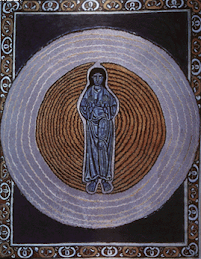
The Creedal outline is at the center. Other Church teaching and discipline radiate out from that center in concentric circles of importance. We will have disagreements about how near the center this or that might be. But, let us debate with passionate patience and humility, taking into account that we all only see as though through a glass darkly.
This does not mean that all disagreements are equal or that all beliefs on matters beyond the Creed are acceptable. I am not shy about weighing in on such things and others. Still, questions, new interpretations of scripture or tradition, and proposed rethinking of various matters of faith will arise among the Church's members. More than we like to believe, much of our interpretations of scripture and tradition can only be provisional. This side of the kingdom they will be incompletely understood, let alone lived. It is part of the Church's vocation in every generation to wrestle reasonably, in the light of scripture and tradition, with whatever questions arise and discern the range of faithful disagreement.
The church - every church - has always had to balance unity and plurality. Perhaps it goes back to a more basic challenge to be both catholic and one while also seeking to be apostolic and holy. In any event, any community has to find its balance while seeking to honor each. While easy appeals to diversity and inclusivity can be cheap and even deceptive, it is also true that the Anglican tradition has typically chosen to error, if it does, on the side of plurality. It is one of the things I find appealing - if sometimes frustrating as well - about the Anglican way.
On any number of issues, I would love to have all Christians (or all Anglicans, or all Episcopalians, or all members of St. Barnabas) agree with my conclusions about what is and is not most faithful. I am inclined for example to agree with Lewis in the quote above. But, as a radical centrist, I am willing to live, even if uncomfortably, with considerable disagreement – and disagreement is inevitable – even on things that I think are fairly near the center as long the disagreement is anchored in the Creed and an honest engagement with scripture and tradition.
No doubt there are problems with such an approach (and I would truly appreciate folk pointing them out). It makes for less clarity and means that fewer things are settled. But the history of division in the body of Christ is also problematic and compromises our witness to the gospel as much as any lack of clarity on theological and moral particulars does.
The great Anglican bishop, Jeremy Taylor (1613-1667) – one who saw the devastation over-certainty and over-definition can do to the church and its witness to the gospel of Jesus Christ – wrote a treatise, (Discourse of the Liberty of Prophesying) in which he pointed out the difficulty of perfect consensus on interpretation of scripture and tradition and argued for the legitimacy of any church that subscribed to the Creed. He was arguing for such liberty within the context of what should be allowed to be legal within the boundaries of the state rather than within the particular body of the Church of England. But, I think it is consistent with the Anglican tradition to expect a basic creedal fidelity while allowing considerable liberty beyond that.
Previous - Next
Friday, September 9, 2011


Tuesday, September 6, 2011
Not a Hobby
This is the sermon I preached ten years ago on September 9, 2001. The sermon I preached on the Sunday after the attacks of 9/11 is here.
Not a Hobby
St. Barnabas Episcopal Church, Glen Ellyn, Illinois
Luke 14:25-33
It was a tough week for religion in the news. On Monday, another Palestinian suicide bomber blew himself up in an attempt to maim or kill others. Then, there were Protestants verbally harassing and stoning little Catholic girls on their way to school in Northern Ireland. The Taliban Islamic government of Afghanistan was also in the news bringing some relief workers to trial, accusing them of seeking to spread Christianity. And then yesterday, we heard about rioting in Nigeria between Moslems and Christians in which at least 50 people have been killed so far.
It makes you wonder if you want to have anything to do with religion or “god stuff” if it’s that problematic. Maybe those who say that religion has done more harm than good in history are right after all.
I’m wondering because in this morning’s gospel Jesus calls us to a radical kind of loyalty. What kind of loyalty is he calling us to? To God? What kind of “god”? No doubt each situation is more complicated than this, but in one way or another in the past week we have seen people kill or attempt some sort of violence in the name of God. Or, at least, loyalty to an idea about “god” was involved.
Is it right to do such things, to kill or be killed in the name of God? The question sounds preposterous to us. One reason, it sounds preposterous to us is because in western society we have become immunized to the power of faith. Culturally, and all too often, personally, we tend to think of religion as a sort of hobby, one step above stamp collecting or bird watching. Some people are into stamp collecting. Some people are into bird watching. Some people are into Christianity. Others are into Buddhism or something else. But it is all more or less a matter of private preference, a hobby. Certainly, it is nothing you would kill someone over, nothing you would risk dying for. Don’t those people in Palestine and Northern Ireland and Nigeria and Afghanistan and everywhere else get that? Don’t they understand this is not a matter of life and death?
Or is it? Is it wrong to kill or die in the name of God? The more I thought about it this week, the more it occurred to me that it is actually a rather interesting question. I’m not sure the answer is altogether obvious. If "god" is the ultimate reality, the ultimate and final good, what else would be worth killing or dying for? If I won’t kill or die in the name of “god”, why would I kill or die for the sake of something less? If not for “god”, why for country? What about ideology, justice, or freedom? Or, as Jesus questions so offensively this morning, family?
For whom or what are we willing to kill? For whom or what are we willing to die? What is worth the ultimate sacrifice of my own life or the responsibility for taking someone else’s? To what or to whom do I pledge such allegiance? If we can answer that set of questions we will get pretty close to what “god” really is for us. Whatever it is to which I am willing to give over that kind of allegiance or loyalty, that kind of sacrifice, is my “god” whether or not I call it religion.
Is it O.K. to kill in the name of God? Ultimately, it depends on what “god” we are talking about, what "god" we are seeking to follow and please. To what or to whom do I pledge such allegiance?
Since their inception, nations and governments have demanded the ultimate sacrifice from their citizens. When your nation says "Go to this place and kill these people", you are expected to obey – to kill and to risk being killed. Others have done the same in the name of abstract ideas such as justice and freedom. More often than not, a varnish of god-talk is added to all of these to lend legitimacy.
I don’t know if the suicide bomber did what he did for “god” or country, or justice, or revenge, or some combination of these. I don’t know enough about Islam to know how he might have thought what he did was pleasing to Allah. I know that not all Moslems would agree with him.
I do know a little bit about Jesus. Following Jesus rules that kind of thing out. You don’t have to be an absolute pacifist to read Jesus and find that his way is not the way of violence. It is hard to justify killing in the name of the one who said, “Turn the other cheek.” It is hard to justify killing in the name of the one who said, “Love your enemy and pray for those who persecute you.” His is not the way of retribution. His is not the way of meanness. Whatever else the Protestants who were hurling invective and stones at the little Catholic girls thought they were doing, they were not following the way of Jesus.
Though, tragically, it has been done; killing in the name of Jesus and the God we know through Jesus is an oxymoron. To die in the name of Jesus and the God we know through him is a different matter. In fact, that is the point. When he says, “Count the cost. Decide now whether or not you are going to be able to finish the building,” that’s what he has in mind. Following Jesus into the heart of God is no hobby.
In this morning’s reading from the Gospel of Luke, Jesus is on his way to Jerusalem and he knows what is in store for him there. He is on a mission, but it is a mission that he knows ends only one way. It ends in his death. He is on his way to Jerusalem, the center of power – political and religious power – and he intends to throw a wrench in the works. He intends to throw a wrench in the usual way of things, the way of intimidation and oppression, the way of coercion, the way of control, the way of violence. More than throw a wrench into the works, Jesus intends to be the wrench in the works to upset the usual machinery of violence and bondage. Ultimately, he came to free us from fundamental bondage of sin and death. But his croos is also a challenge to the myriad ways sin and death are manifest in this world and a call to resist them.
To those who are following him, he lays out his agenda pretty clearly. “If you think you are following me in some sort of victorious parade in which we are going to march into Jerusalem, take things over, kick the Romans out, and set the temple worship straight, you’ve got the wrong guy. If you want to follow me into Jerusalem, take up the cross and follow me. Take up the cross and prepare to die.” To follow Jesus is to follow him in that mission, the mission to upset the usual way of things – the way of things we see on the nightly news and in the morning paper.
Sometimes that might mean actual martyrdom. There have been places and times when people have literally died for the sake of that mission. There are people in the world now for whom that is a day-to-day possibility. But for most of us, most of the time, it is the daily martyrdom of dying to self and learning to live in love for the other. That, too, is taking up our cross and following Jesus.
There is only one cross. Sometimes people talk about “their cross to bear” as if each of us had his or her own individual cross. “I have this problematic child and she is my cross to bear.” Or, “I have this illness and that is my cross to bear.” Or, “I am in this relationship where I am being abused and that is my cross to bear.” That is a misappropriation of what Jesus is calling us to. Taking up your cross and following Jesus is not resigning yourself to being abused and trapped in a situation beyond your control. It is a call to servanthood not servitude. Taking up the cross of Christ is choosing freely to follow him in his mission of resistance, his mission of proclaiming mercy and grace. There is only one cross, and it is the cross of Christ. Ultimately, he bears that cross with us. He is on the cross with us and before us.
Jesus challenges us to put all other loyalties in the context of his mission, all other loyalties in the context of the cross. When Christians marry, they marry with that mission in mind. Marriage is one place and one way we can serve the mission. We can learn to love. We can learn to give totally of ourselves. We can create space where the stranger is welcome and generosity is given. If we choose to be single, we choose to be single for the same reason, because sometimes being single is the best way to serve the mission. If we choose to have children that, too, is not something that just happens. That’s something we do because having children is a way of witnessing to the mission, to the kingdom, and to raise up new disciples, new witnesses. All loyalties – families, friends, nation – are redefined in the context of that ultimate loyalty to the way of Jesus, the way of the cross.
Jesus does not say "focus on the family;" he says "focus on the cross." And there are no precious moments on the way of the cross. Dietrich Bonhoeffer wrote, “The cross of Christ destroyed the equation that religion equals happiness.” That might be overstating the case just a bit. As we sang in the opening hymn (483), the cross is also our life and our health. It is the way of grace, the way of joy. But certainly the call to take up our cross destroys the equation that religion - at least religion that is true to Christ - equals sentimentality and nostalgia. It also destroyed the equation that religion is compatible with the way of violence and control.
The way of the cross is the way of Jesus and it is the way to which he calls us. It is the way of dying to self and living toward the other. It is the way of servanthood. It is the way of reaching out to the stranger, of proclaiming God’s favor, God’s mercy. Those of us who have experienced that mercy are called to embody it to those who do not yet know it. We are called to be the peace of Christ, not just to pass it, but to be it. We are called to be people of forgiveness, people who know how to love our enemy, people who know what it means to welcome the stranger. Protestants welcome Catholics. Catholics welcome Protestants. Christians welcome Jews. Christians love and welcome Moslems.
We are called to a life of resolute kindness and peace. It is the way of the cross. It is the way of Christ. It is a call to resist all that says "no" to the goodness of God’s creation and to the worth of each person. It is a call to be, in ways small and great, wrenches in the usual way of things, to break up the machinery of the way things usually go. It is a call to creatively and effectively disrupt the cycle of violence. It is a call to live lives of gentleness, kindness, peace, and justice in a world of violence and hate. It is a kind of martyrdom. It is not a hobby.
Not a Hobby
St. Barnabas Episcopal Church, Glen Ellyn, Illinois
Luke 14:25-33
It was a tough week for religion in the news. On Monday, another Palestinian suicide bomber blew himself up in an attempt to maim or kill others. Then, there were Protestants verbally harassing and stoning little Catholic girls on their way to school in Northern Ireland. The Taliban Islamic government of Afghanistan was also in the news bringing some relief workers to trial, accusing them of seeking to spread Christianity. And then yesterday, we heard about rioting in Nigeria between Moslems and Christians in which at least 50 people have been killed so far.
It makes you wonder if you want to have anything to do with religion or “god stuff” if it’s that problematic. Maybe those who say that religion has done more harm than good in history are right after all.
I’m wondering because in this morning’s gospel Jesus calls us to a radical kind of loyalty. What kind of loyalty is he calling us to? To God? What kind of “god”? No doubt each situation is more complicated than this, but in one way or another in the past week we have seen people kill or attempt some sort of violence in the name of God. Or, at least, loyalty to an idea about “god” was involved.
Is it right to do such things, to kill or be killed in the name of God? The question sounds preposterous to us. One reason, it sounds preposterous to us is because in western society we have become immunized to the power of faith. Culturally, and all too often, personally, we tend to think of religion as a sort of hobby, one step above stamp collecting or bird watching. Some people are into stamp collecting. Some people are into bird watching. Some people are into Christianity. Others are into Buddhism or something else. But it is all more or less a matter of private preference, a hobby. Certainly, it is nothing you would kill someone over, nothing you would risk dying for. Don’t those people in Palestine and Northern Ireland and Nigeria and Afghanistan and everywhere else get that? Don’t they understand this is not a matter of life and death?
Or is it? Is it wrong to kill or die in the name of God? The more I thought about it this week, the more it occurred to me that it is actually a rather interesting question. I’m not sure the answer is altogether obvious. If "god" is the ultimate reality, the ultimate and final good, what else would be worth killing or dying for? If I won’t kill or die in the name of “god”, why would I kill or die for the sake of something less? If not for “god”, why for country? What about ideology, justice, or freedom? Or, as Jesus questions so offensively this morning, family?
For whom or what are we willing to kill? For whom or what are we willing to die? What is worth the ultimate sacrifice of my own life or the responsibility for taking someone else’s? To what or to whom do I pledge such allegiance? If we can answer that set of questions we will get pretty close to what “god” really is for us. Whatever it is to which I am willing to give over that kind of allegiance or loyalty, that kind of sacrifice, is my “god” whether or not I call it religion.
Is it O.K. to kill in the name of God? Ultimately, it depends on what “god” we are talking about, what "god" we are seeking to follow and please. To what or to whom do I pledge such allegiance?
Since their inception, nations and governments have demanded the ultimate sacrifice from their citizens. When your nation says "Go to this place and kill these people", you are expected to obey – to kill and to risk being killed. Others have done the same in the name of abstract ideas such as justice and freedom. More often than not, a varnish of god-talk is added to all of these to lend legitimacy.
I don’t know if the suicide bomber did what he did for “god” or country, or justice, or revenge, or some combination of these. I don’t know enough about Islam to know how he might have thought what he did was pleasing to Allah. I know that not all Moslems would agree with him.
I do know a little bit about Jesus. Following Jesus rules that kind of thing out. You don’t have to be an absolute pacifist to read Jesus and find that his way is not the way of violence. It is hard to justify killing in the name of the one who said, “Turn the other cheek.” It is hard to justify killing in the name of the one who said, “Love your enemy and pray for those who persecute you.” His is not the way of retribution. His is not the way of meanness. Whatever else the Protestants who were hurling invective and stones at the little Catholic girls thought they were doing, they were not following the way of Jesus.
Though, tragically, it has been done; killing in the name of Jesus and the God we know through Jesus is an oxymoron. To die in the name of Jesus and the God we know through him is a different matter. In fact, that is the point. When he says, “Count the cost. Decide now whether or not you are going to be able to finish the building,” that’s what he has in mind. Following Jesus into the heart of God is no hobby.
In this morning’s reading from the Gospel of Luke, Jesus is on his way to Jerusalem and he knows what is in store for him there. He is on a mission, but it is a mission that he knows ends only one way. It ends in his death. He is on his way to Jerusalem, the center of power – political and religious power – and he intends to throw a wrench in the works. He intends to throw a wrench in the usual way of things, the way of intimidation and oppression, the way of coercion, the way of control, the way of violence. More than throw a wrench into the works, Jesus intends to be the wrench in the works to upset the usual machinery of violence and bondage. Ultimately, he came to free us from fundamental bondage of sin and death. But his croos is also a challenge to the myriad ways sin and death are manifest in this world and a call to resist them.
To those who are following him, he lays out his agenda pretty clearly. “If you think you are following me in some sort of victorious parade in which we are going to march into Jerusalem, take things over, kick the Romans out, and set the temple worship straight, you’ve got the wrong guy. If you want to follow me into Jerusalem, take up the cross and follow me. Take up the cross and prepare to die.” To follow Jesus is to follow him in that mission, the mission to upset the usual way of things – the way of things we see on the nightly news and in the morning paper.
Sometimes that might mean actual martyrdom. There have been places and times when people have literally died for the sake of that mission. There are people in the world now for whom that is a day-to-day possibility. But for most of us, most of the time, it is the daily martyrdom of dying to self and learning to live in love for the other. That, too, is taking up our cross and following Jesus.
There is only one cross. Sometimes people talk about “their cross to bear” as if each of us had his or her own individual cross. “I have this problematic child and she is my cross to bear.” Or, “I have this illness and that is my cross to bear.” Or, “I am in this relationship where I am being abused and that is my cross to bear.” That is a misappropriation of what Jesus is calling us to. Taking up your cross and following Jesus is not resigning yourself to being abused and trapped in a situation beyond your control. It is a call to servanthood not servitude. Taking up the cross of Christ is choosing freely to follow him in his mission of resistance, his mission of proclaiming mercy and grace. There is only one cross, and it is the cross of Christ. Ultimately, he bears that cross with us. He is on the cross with us and before us.
Jesus challenges us to put all other loyalties in the context of his mission, all other loyalties in the context of the cross. When Christians marry, they marry with that mission in mind. Marriage is one place and one way we can serve the mission. We can learn to love. We can learn to give totally of ourselves. We can create space where the stranger is welcome and generosity is given. If we choose to be single, we choose to be single for the same reason, because sometimes being single is the best way to serve the mission. If we choose to have children that, too, is not something that just happens. That’s something we do because having children is a way of witnessing to the mission, to the kingdom, and to raise up new disciples, new witnesses. All loyalties – families, friends, nation – are redefined in the context of that ultimate loyalty to the way of Jesus, the way of the cross.
Jesus does not say "focus on the family;" he says "focus on the cross." And there are no precious moments on the way of the cross. Dietrich Bonhoeffer wrote, “The cross of Christ destroyed the equation that religion equals happiness.” That might be overstating the case just a bit. As we sang in the opening hymn (483), the cross is also our life and our health. It is the way of grace, the way of joy. But certainly the call to take up our cross destroys the equation that religion - at least religion that is true to Christ - equals sentimentality and nostalgia. It also destroyed the equation that religion is compatible with the way of violence and control.
The way of the cross is the way of Jesus and it is the way to which he calls us. It is the way of dying to self and living toward the other. It is the way of servanthood. It is the way of reaching out to the stranger, of proclaiming God’s favor, God’s mercy. Those of us who have experienced that mercy are called to embody it to those who do not yet know it. We are called to be the peace of Christ, not just to pass it, but to be it. We are called to be people of forgiveness, people who know how to love our enemy, people who know what it means to welcome the stranger. Protestants welcome Catholics. Catholics welcome Protestants. Christians welcome Jews. Christians love and welcome Moslems.
We are called to a life of resolute kindness and peace. It is the way of the cross. It is the way of Christ. It is a call to resist all that says "no" to the goodness of God’s creation and to the worth of each person. It is a call to be, in ways small and great, wrenches in the usual way of things, to break up the machinery of the way things usually go. It is a call to creatively and effectively disrupt the cycle of violence. It is a call to live lives of gentleness, kindness, peace, and justice in a world of violence and hate. It is a kind of martyrdom. It is not a hobby.
Monday, August 29, 2011
N. T. Wright on the Enduring Mission of the Church
New Testament scholar and erstwhile Bishop of Durham, N. T. Wright has written an article for The Spectator, a British news magazine. Some of what he writes here is peculiar to the Church of England. But most of it is also true of the Episcopal Church - and other churches as well. Here are a couple of excerpts (the whole article can be found here):
Check out the volunteers in the prison, in the hospice, in charity shops. It’s remarkable how many of them are practising Christians. They aren’t volunteering because the government has told them we can’t afford to pay for such work any more. They do it because of Jesus. Often they aren’t very articulate about this. They just find, in their bones, that they need and want to help, especially when things are really dire. But if you trace this awareness to its source, you’ll find, as often as not, that the lines lead back to a parish church or near equivalent, to the regular reading of the Bible, to the life of prayer and sacrament and fellowship. To the regular saying and singing of prayers and hymns that announce, however surprising or shocking it may be to our sceptical world, that God is God, that Jesus is Lord, that the Holy Spirit is alive and well and active in a community near you.
Despite two centuries of being told the opposite, in fact, the Church can’t help itself. Secular modernism still likes to pretend that the world runs itself, and that ‘religion’ has to do with private spirituality and otherworldly hope. The Church — not least those who want to create a ‘pure’ type of Christianity, and look either to Rome or to a ‘biblical’ sect to provide it — has often colluded with this secularist shrinking of the task. But the genuinely biblical vision, rooted in the four gospels, is of God already being king of the world, through the victory of Jesus. ‘All authority in heaven and on earth,’ said Jesus, ‘has been given to me.’ And on earth. The Church exists to demonstrate what that means.
It exists, in other words, to do and be for the world what Jesus had been for his contemporaries: to bring healing and hope, to rescue people trapped in their own folly and sin, to straighten out the distorted pictures of reality that every age manages to produce, and to enable people to live by, and in, God’s true reality. It exists not to rescue people from the world but to rescue them for the world: to see lives transformed by the gospel so that people can discover a new depth and resonance of what it means to be human, precisely by looking beyond themselves to God, to the beauties and glories of his creation, and to their neighbours, particularly those in need. The Church does this through liturgy and laughter; through music and drug-rehabilitation programmes; through prayer and protest marches; through preaching and campaigning; through soaking itself in the Bible and immersing itself in the needs of the world. When God wants to change the world, he doesn’t send in the tanks (as many, including many critics, think he should). He sends in the meek; and by the time the world realises what’s going on, the meek have set up clinics and schools, taught people to read and to sing, and given them a hope, meaning and purpose which secular modernism (which gave us, after all, Passchendaele and Auschwitz as well as modern medicine and space travel) has failed to provide.
Saying that Jesus is now in charge, still more that the church is the agent of this project, has been rubbished for generations. The litany is familiar, though interestingly limited and repetitive: crusades, the Inquisition, witch-burning and so on. No church worth its salt will deny that it has made huge mistakes. We still say ‘forgive us our trespasses’ every day, only wishing that others would join us in this penitence. But the reason the anti-Christian brigade point out the Church’s failures is that, just as in Marxist totalitarianism the state replaces God, making it atheist de jure and not simply de facto, so in secular democracy the state attempts to replace the Church. That is why the Church is pushed to the margins, told to mind its own spiritual business and not to get involved in international debt or the treatment of asylum-seekers. As we survey the result — crooked politicians, bent coppers, bloated bankers, spying journalists — it may be time for the church to be more humbly confident in getting on with its proper vocation, leading the way in the true Big Society, bringing healing and hope at every level.
. . .
Away from the pressure groups and the single-issue fanatics, the Church has a massive local strength on which we must build.
To do this, it must do the core tasks well. The only way to resist being squeezed into the tired old mould of modernism or the nihilistic anything-goes world of postmodernism is through that strange combination of worship and prayer on the one hand, and biblically based theology on the other, for which the Church of England has, historically, an excellent track record. Only when the Church is constantly refreshed in these ways will it be able to discern which of the agendas that infatuate today’s world are true gospel imperatives and which are a snare and a delusion. (For a start, a biblical theology would have a lot more to say about money and power than about sex, important though that is too.) The next generation of church leaders will need to be on their toes to articulate a vision of human community which our pragmatic, short-term politicians have all but forgotten, and to know how to speak the truth to power in a way for which our prurient, sniggering journalism provides a ghastly parody. I sometimes suspect that the pressure, from some politicians and some journalists, for the Church to retreat to the sidelines is because both know, deep down, that the Church — and especially, despite everything, the Church of England — still has the ability to speak the truth and shame the devil.
None of this, of course, provides the answer to the questions about women bishops, or gay clergy, or the Anglican Communion, or how to relate to our Muslim neighbours. But if you put the hard questions in the centre of the picture, everything else gets distorted. Let’s take a deep breath and remind ourselves of our real focus: the kingdom of God, the lordship of Jesus, and the power of the Holy Spirit. Then, as Jesus himself nearly said, everything else will fall into perspective. At its best — and there is a lot of the ‘best’ out there — this is what the Church of England is all about.
Check out the volunteers in the prison, in the hospice, in charity shops. It’s remarkable how many of them are practising Christians. They aren’t volunteering because the government has told them we can’t afford to pay for such work any more. They do it because of Jesus. Often they aren’t very articulate about this. They just find, in their bones, that they need and want to help, especially when things are really dire. But if you trace this awareness to its source, you’ll find, as often as not, that the lines lead back to a parish church or near equivalent, to the regular reading of the Bible, to the life of prayer and sacrament and fellowship. To the regular saying and singing of prayers and hymns that announce, however surprising or shocking it may be to our sceptical world, that God is God, that Jesus is Lord, that the Holy Spirit is alive and well and active in a community near you.
Despite two centuries of being told the opposite, in fact, the Church can’t help itself. Secular modernism still likes to pretend that the world runs itself, and that ‘religion’ has to do with private spirituality and otherworldly hope. The Church — not least those who want to create a ‘pure’ type of Christianity, and look either to Rome or to a ‘biblical’ sect to provide it — has often colluded with this secularist shrinking of the task. But the genuinely biblical vision, rooted in the four gospels, is of God already being king of the world, through the victory of Jesus. ‘All authority in heaven and on earth,’ said Jesus, ‘has been given to me.’ And on earth. The Church exists to demonstrate what that means.
It exists, in other words, to do and be for the world what Jesus had been for his contemporaries: to bring healing and hope, to rescue people trapped in their own folly and sin, to straighten out the distorted pictures of reality that every age manages to produce, and to enable people to live by, and in, God’s true reality. It exists not to rescue people from the world but to rescue them for the world: to see lives transformed by the gospel so that people can discover a new depth and resonance of what it means to be human, precisely by looking beyond themselves to God, to the beauties and glories of his creation, and to their neighbours, particularly those in need. The Church does this through liturgy and laughter; through music and drug-rehabilitation programmes; through prayer and protest marches; through preaching and campaigning; through soaking itself in the Bible and immersing itself in the needs of the world. When God wants to change the world, he doesn’t send in the tanks (as many, including many critics, think he should). He sends in the meek; and by the time the world realises what’s going on, the meek have set up clinics and schools, taught people to read and to sing, and given them a hope, meaning and purpose which secular modernism (which gave us, after all, Passchendaele and Auschwitz as well as modern medicine and space travel) has failed to provide.
Saying that Jesus is now in charge, still more that the church is the agent of this project, has been rubbished for generations. The litany is familiar, though interestingly limited and repetitive: crusades, the Inquisition, witch-burning and so on. No church worth its salt will deny that it has made huge mistakes. We still say ‘forgive us our trespasses’ every day, only wishing that others would join us in this penitence. But the reason the anti-Christian brigade point out the Church’s failures is that, just as in Marxist totalitarianism the state replaces God, making it atheist de jure and not simply de facto, so in secular democracy the state attempts to replace the Church. That is why the Church is pushed to the margins, told to mind its own spiritual business and not to get involved in international debt or the treatment of asylum-seekers. As we survey the result — crooked politicians, bent coppers, bloated bankers, spying journalists — it may be time for the church to be more humbly confident in getting on with its proper vocation, leading the way in the true Big Society, bringing healing and hope at every level.
. . .
Away from the pressure groups and the single-issue fanatics, the Church has a massive local strength on which we must build.
To do this, it must do the core tasks well. The only way to resist being squeezed into the tired old mould of modernism or the nihilistic anything-goes world of postmodernism is through that strange combination of worship and prayer on the one hand, and biblically based theology on the other, for which the Church of England has, historically, an excellent track record. Only when the Church is constantly refreshed in these ways will it be able to discern which of the agendas that infatuate today’s world are true gospel imperatives and which are a snare and a delusion. (For a start, a biblical theology would have a lot more to say about money and power than about sex, important though that is too.) The next generation of church leaders will need to be on their toes to articulate a vision of human community which our pragmatic, short-term politicians have all but forgotten, and to know how to speak the truth to power in a way for which our prurient, sniggering journalism provides a ghastly parody. I sometimes suspect that the pressure, from some politicians and some journalists, for the Church to retreat to the sidelines is because both know, deep down, that the Church — and especially, despite everything, the Church of England — still has the ability to speak the truth and shame the devil.
None of this, of course, provides the answer to the questions about women bishops, or gay clergy, or the Anglican Communion, or how to relate to our Muslim neighbours. But if you put the hard questions in the centre of the picture, everything else gets distorted. Let’s take a deep breath and remind ourselves of our real focus: the kingdom of God, the lordship of Jesus, and the power of the Holy Spirit. Then, as Jesus himself nearly said, everything else will fall into perspective. At its best — and there is a lot of the ‘best’ out there — this is what the Church of England is all about.
Friday, August 26, 2011
Monday, August 22, 2011
A Living Sacrifice
Yesterday’s sermon (Romans 12:1-8, Matthew 16:13-20):
“I appeal to you therefore, brothers and sisters . . .” When we are reading scripture and come across a “therefore” we should stop and ask, “What is the ‘therefore’ there for?” And it is important that we do just that as we look at this lesson from Romans 12. What has gone before to set up Paul’s therefore? In the first eleven chapters of Romans Paul has been, in various ways, writing about the amazing grace and inscrutable mercy of God. More specifically, for the last three chapters Paul has been contemplating the relationship of the people of Israel to the good news of Jesus Christ – Jesus the Messiah – which the Jews have for the most part rejected even as more and more gentiles accept it. Paul ends that contemplation with an exultant reveling in the mysterious, persistent mercy God makes available to all.
And it is because of that mind-boggling mercy that Paul says "therefore" – “I appeal to you therefore, brothers and sisters, by the mercies of God, to present your bodies as a living sacrifice, holy and acceptable to God, which is your spiritual worship. Do not be conformed to this world, but be transformed by the renewing of your minds, so that you may discern what is the will of God—what is good and acceptable and perfect.” Given God’s mercy, we should respond by presenting our bodies as a living sacrifice.
But, what does that look like? To begin with, the rest of Romans 12 is one of Paul’s attempts to explain what it looks like. We will look at the rest of Romans 12 next week. This morning I want to offer an example of one whose life was a living sacrifice and, indeed, was the kind of rock Jesus is talking about in the Gospel against which the very gates of Hades cannot prevail. It’s the story of Maria Yudina, a great Russian pianist and a friend of composer Dimitri Shostakovich.
The following is from The Ladder of the Beatitudes by Jim Forest which I have been reading as part of my morning devotions:
It was Maria Yudina’s fate to live through the Russian revolution and its aftermath, seeing many of her dearest friends and colleagues disappear into the Gulag. A fearless Christian, she wore a cross visibly even while teaching or performing in public – an affirmation of belief at a time when the price of a display of religious faith could be one’s work, one’s freedom, even one’s life. She lived an ascetic life, wearing no cosmetics, spending little on herself, and dressing simply. “I had the impression that Yudina wore the same black dress during her entire long life, it was so worn and soiled,” said Shostakovich.(50)[this and other references are from Testimony:The Memoirs of Shostakovich, Solomon Volkov, ed.]
For Maria Yudina, music was a way of proclaiming her faith in a period when presses were more carefully policed than pianos. “Yudina saw music in a mystical light. For instance, she saw Bach’s Goldberg Variations as a series of illustrations to the Holy Bible,” said Shostakovich. “She always played as though she were giving a sermon.”(51)
She not only performed piano works but paused during concerts to read the poetry of such writers as Boris Pasternak, who were unable to publish at the time.
She was notorious among friends for her inability to keep anything of value for herself. “She came to see me once,” Shostakovich recalled, “and said that she was living in a miserable little room where she could neither work nor rest. So I signed a petition, I went to see various bureaucrats, I asked a lot of people to help, I took up a lot of people’s time. With great difficulty we got an apartment for Yudina. You would think that everything was fine and that life could go on. A short time later she came to me again and asked for help in obtaining an apartment for herself. ‘What? But we got an apartment for you. What do you need another one for?’ ‘I gave the apartment away to a poor old woman.’”(52)
Shostakovich heard that friends had made a loan to Yudina of five rubles. “I broke a window in my room, it’s drafty and so cold, I can’t live like that,” she had told them. “Naturally, they gave her the money—it was winter. A while later they visited her, and it was as cold in her room as it was outside and the broken window was stuffed with a rag. ‘How can this be, Maria Veniaminovna? We gave you money to fix the window.’ And she replied, ‘I gave it for the needs of the church’”(53)
Shostakovich, who regarded religion as superstition, didn’t approve. “The church may have various needs,” he protested, “but the clergy doesn’t sit around in the cold, after all, with broken windows. Self-denial should have a rational limit.” He accused her of behaving like a yurodivye, the Russian word for a holy fool, a form of sanctity in the eyes of the church.
Her public profession of faith was not without cost. Despite her genius as a musician, from time to time she was banned from concert halls and not once in her life was she allowed to travel outside Russia. Shostakovich remembered:
From time to time she all but signed her own death warrant. Perhaps the most remarkable story in Shostakovich’s memoir concerns one such incident:
Shostakovich found Yudina’s open display of belief foolish, yet one senses within his complaints both envy and awe. In a time of heart-stopping fear, here was someone as fearless as St. George before the dragon, someone who preferred giving away her few rubles to repairing her own broken window, who “published” with her own voice the poems of banned writers, who dared to tell Stalin he was not beyond God’s mercy and forgiveness. She had a large and pure heart. No wonder her grave in Moscow has been a place of pilgrimage ever since her death.
[The Ladder of the Beatitudes by Jim Forest, p. 99-103]
I appeal to you therefore, brothers and sisters, by the mercies of God, to present your bodies as a living sacrifice, holy and acceptable to God, which is your spiritual worship. Do not be conformed to this world, but be transformed by the renewing of your minds, so that you may discern what is the will of God—what is good and acceptable and perfect.
“I appeal to you therefore, brothers and sisters . . .” When we are reading scripture and come across a “therefore” we should stop and ask, “What is the ‘therefore’ there for?” And it is important that we do just that as we look at this lesson from Romans 12. What has gone before to set up Paul’s therefore? In the first eleven chapters of Romans Paul has been, in various ways, writing about the amazing grace and inscrutable mercy of God. More specifically, for the last three chapters Paul has been contemplating the relationship of the people of Israel to the good news of Jesus Christ – Jesus the Messiah – which the Jews have for the most part rejected even as more and more gentiles accept it. Paul ends that contemplation with an exultant reveling in the mysterious, persistent mercy God makes available to all.
And it is because of that mind-boggling mercy that Paul says "therefore" – “I appeal to you therefore, brothers and sisters, by the mercies of God, to present your bodies as a living sacrifice, holy and acceptable to God, which is your spiritual worship. Do not be conformed to this world, but be transformed by the renewing of your minds, so that you may discern what is the will of God—what is good and acceptable and perfect.” Given God’s mercy, we should respond by presenting our bodies as a living sacrifice.
But, what does that look like? To begin with, the rest of Romans 12 is one of Paul’s attempts to explain what it looks like. We will look at the rest of Romans 12 next week. This morning I want to offer an example of one whose life was a living sacrifice and, indeed, was the kind of rock Jesus is talking about in the Gospel against which the very gates of Hades cannot prevail. It’s the story of Maria Yudina, a great Russian pianist and a friend of composer Dimitri Shostakovich.
The following is from The Ladder of the Beatitudes by Jim Forest which I have been reading as part of my morning devotions:
It was Maria Yudina’s fate to live through the Russian revolution and its aftermath, seeing many of her dearest friends and colleagues disappear into the Gulag. A fearless Christian, she wore a cross visibly even while teaching or performing in public – an affirmation of belief at a time when the price of a display of religious faith could be one’s work, one’s freedom, even one’s life. She lived an ascetic life, wearing no cosmetics, spending little on herself, and dressing simply. “I had the impression that Yudina wore the same black dress during her entire long life, it was so worn and soiled,” said Shostakovich.(50)[this and other references are from Testimony:The Memoirs of Shostakovich, Solomon Volkov, ed.]
For Maria Yudina, music was a way of proclaiming her faith in a period when presses were more carefully policed than pianos. “Yudina saw music in a mystical light. For instance, she saw Bach’s Goldberg Variations as a series of illustrations to the Holy Bible,” said Shostakovich. “She always played as though she were giving a sermon.”(51)
She not only performed piano works but paused during concerts to read the poetry of such writers as Boris Pasternak, who were unable to publish at the time.
She was notorious among friends for her inability to keep anything of value for herself. “She came to see me once,” Shostakovich recalled, “and said that she was living in a miserable little room where she could neither work nor rest. So I signed a petition, I went to see various bureaucrats, I asked a lot of people to help, I took up a lot of people’s time. With great difficulty we got an apartment for Yudina. You would think that everything was fine and that life could go on. A short time later she came to me again and asked for help in obtaining an apartment for herself. ‘What? But we got an apartment for you. What do you need another one for?’ ‘I gave the apartment away to a poor old woman.’”(52)
Shostakovich heard that friends had made a loan to Yudina of five rubles. “I broke a window in my room, it’s drafty and so cold, I can’t live like that,” she had told them. “Naturally, they gave her the money—it was winter. A while later they visited her, and it was as cold in her room as it was outside and the broken window was stuffed with a rag. ‘How can this be, Maria Veniaminovna? We gave you money to fix the window.’ And she replied, ‘I gave it for the needs of the church’”(53)
Shostakovich, who regarded religion as superstition, didn’t approve. “The church may have various needs,” he protested, “but the clergy doesn’t sit around in the cold, after all, with broken windows. Self-denial should have a rational limit.” He accused her of behaving like a yurodivye, the Russian word for a holy fool, a form of sanctity in the eyes of the church.
Her public profession of faith was not without cost. Despite her genius as a musician, from time to time she was banned from concert halls and not once in her life was she allowed to travel outside Russia. Shostakovich remembered:
Her religious position was under constant . . . attack (at the music school in Leningrad). Once [some officials] rushed into Yudina’s class and demanded of Yudina: “Do you believe in God?” She replied in the affirmative. “Was she promoting religious propaganda among her students?” She replied that the Constitution didn’t forbid it. A few days later a transcript of the conversation made by “an unknown person” appeared in a Leningrad paper, which also printed a caricature—Yudina in nun’s robes surrounded by kneeling students. And the caption was something about preachers appearing at the Conservatoire. . . Naturally, Yudina was dismissed after that.(54)
From time to time she all but signed her own death warrant. Perhaps the most remarkable story in Shostakovich’s memoir concerns one such incident:
In his final years, Stalin seemed more and more like a madman, and I think his superstition grew. The “Leader and Teacher” sat locked up in one of his many dachas, amusing himself in bizarre ways. . . . [He] didn’t let anyone in to see him for days at a time. He listened to the radio a lot. Once Stalin called the Radio committee . . . and asked if they had a record of Mozart’s Piano Concerto No. 23, which had been heard on the radio the day before. “Played by Yudina,” he added. They told Stalin that of course they had it. Actually, there was no record, the concert has been live. But they were afraid to say no to Stalin, no one ever knew what the consequences might be. A human life meant nothing to him. All you could do was agree, submit, be a yes-man, a yes-man to a madman.
Stalin demanded that they send the record with Yudina’s performance of the Mozart to his dacha. The committee panicked, but they had to do something. They called in Yudina and an orchestra and recorded that night. Everyone was shaking with fright, except for Yudina, naturally. But, she was a special case, that one, the ocean was only knee-deep for her.
Yudina later told me that they had to send the conductor home, he was so scared he couldn’t think. They called another conductor who trembled and got everything mixed up, confusing the orchestra. Only a third conductor was in any shape to finish the recording.
I think this is a unique event in the history of recording-I mean, changing conductors three times in one night. Anyway, the record was ready by morning. They made one single copy in record time and sent it to Stalin. Now that was a record. A record in yes-ing.
Soon after, Yudina received an envelope with twenty thousand rubles. She was told it came on the express orders of Stalin. Then she wrote him a letter. I know about this letter from her, I know that the story seems improbable. Yudina had many quirks, but I can say this – she never lied. I’m certain that her story is true. Yudina wrote something like this in her letter: “I thank you, Joseph Vissarionovich, for your aid. I will pray for you day and night and ask the Lord to forgive your great sins before the people and the country. The Lord is merciful and He’ll forgive you. I gave the money to the church that I attend."
And Yudina sent this suicidal letter to Stalin. He read it and didn’t say a word, they expected at least a twitch of the eyebrow. Naturally, the order to arrest Yudina was prepared and the slightest grimace would have been enough to wipe away the last traces of her. But Stalin was silent and set the letter aside in silence. The anticipated movement of the eyebrows didn’t come. Nothing happened to Yudina. They say that her recording of the Mozart was on the record player when the “Leader and Teacher” was found dead in his dacha. It was the last thing he had listened to.(55)
Shostakovich found Yudina’s open display of belief foolish, yet one senses within his complaints both envy and awe. In a time of heart-stopping fear, here was someone as fearless as St. George before the dragon, someone who preferred giving away her few rubles to repairing her own broken window, who “published” with her own voice the poems of banned writers, who dared to tell Stalin he was not beyond God’s mercy and forgiveness. She had a large and pure heart. No wonder her grave in Moscow has been a place of pilgrimage ever since her death.
[The Ladder of the Beatitudes by Jim Forest, p. 99-103]
I appeal to you therefore, brothers and sisters, by the mercies of God, to present your bodies as a living sacrifice, holy and acceptable to God, which is your spiritual worship. Do not be conformed to this world, but be transformed by the renewing of your minds, so that you may discern what is the will of God—what is good and acceptable and perfect.
Friday, August 19, 2011
Creed and Mystery
O inexpressible mystery and unheard paradox: the Invisible is seen, the Intangible is touched, the Eternal Word becomes accessible to our speech, the Timeless steps into time, the Son of God becomes the Son of Man. – Gregory of Nyssa
No sooner do I conceive of the One than I am illumined by the Splendor of the Three; no sooner do I distinguish them than I am carried back to the One. When I think of any One of the Three I think of him as the whole, and my eyes are filled, and the greater part of what I am thinking escapes me. – Gregory of Nazianzuz
Radical Centrist Manifesto VIII
III. Centered in the Body of Christ,
Part 2: Centered in the Creed, iii
I suspect some folk have difficulty with the Creed because it feels too definite and thus intrudes on a sense of mystery. But, I suggest the Creeds actually “preserve” the mystery from domestication while focusing our attention on the mystery within the context of revelation.
It is true that the Creed is the outline of a story which, as I've pointed out before, calls other stories into question - while not closing off the very real possibility of God's being present in those stories. As we’ve seen before, whether it is this story or another, whether or not we are conscious of the story that shapes us, there is no escaping this.
It is also true that the Creed serves as our Pledge of Allegiance – to the faith of the Church, to the Church’s Lord, and its members one to another. And this declaration of loyalty/faithfulness will call into question all other loyalties.
Both of these will be stumbling blocks to those of us shaped by certain modern assumptions.
But, that is not because the Creed reduces mystery. The Creeds focus us on mystery within the context of the revelation of God in Jesus Christ through the Holy Spirit. There is plenty of mystery and much escapes our understanding. But, we are not left with nothing but guessing about God. The Creeds began as baptismal formulae and through baptism we are invited into the mystery of a God who is One, yet Threefold. We are invited into the mystery of a God who does not remain aloof, but became one with humanity and the dusty world through the Incarnation - for us and for our salvation. We are invited into the mystery of Jesus Christ who is, in a mystery beyond our comprehending, both human and divine. We are invited into the mystery of the forgiveness of sin. And so on.
Rather than constraining mystery, the Creeds, particularly the Nicene Creed, were conceived as means to preserve that mystery from the tendency to domesticate Christian faith in one way or another to make it less paradoxical or more intellectually comfortable. That is one way to understand the various heresies rejected by the Church. It was the heretics who in fact presumed to know more about the mystery of God than is prudent, not those who defended what came to be known as the “catholic” faith summarized in the Creeds. It was the heretics, not the orthodox, who insisted on resolving paradoxes like the Incarnation and the Triune character of the Godhead. The Creed is the Christian way into the the mystery of God.
Believing the Creed doesn’t mean that now we fully understand God - not by a long shot. It’s just that, as Rowan Williams has said, given what we know through Jesus and the Holy Spirit, this is the least silly language for God we have. So, while we can say it with some confidence, it is good, even at our most confident, to say it with humility, maybe even trepidation. And we do well to take care in claiming we know too well what we mean when we say we believe it or what the implications are. God remains an awesome mystery even given God's gift of revealing something of the mystery through Jesus Christ and his Holy Spirit.
Previous - Next
No sooner do I conceive of the One than I am illumined by the Splendor of the Three; no sooner do I distinguish them than I am carried back to the One. When I think of any One of the Three I think of him as the whole, and my eyes are filled, and the greater part of what I am thinking escapes me. – Gregory of Nazianzuz
Radical Centrist Manifesto VIII
III. Centered in the Body of Christ,
Part 2: Centered in the Creed, iii
I suspect some folk have difficulty with the Creed because it feels too definite and thus intrudes on a sense of mystery. But, I suggest the Creeds actually “preserve” the mystery from domestication while focusing our attention on the mystery within the context of revelation.
It is true that the Creed is the outline of a story which, as I've pointed out before, calls other stories into question - while not closing off the very real possibility of God's being present in those stories. As we’ve seen before, whether it is this story or another, whether or not we are conscious of the story that shapes us, there is no escaping this.
It is also true that the Creed serves as our Pledge of Allegiance – to the faith of the Church, to the Church’s Lord, and its members one to another. And this declaration of loyalty/faithfulness will call into question all other loyalties.
Both of these will be stumbling blocks to those of us shaped by certain modern assumptions.
But, that is not because the Creed reduces mystery. The Creeds focus us on mystery within the context of the revelation of God in Jesus Christ through the Holy Spirit. There is plenty of mystery and much escapes our understanding. But, we are not left with nothing but guessing about God. The Creeds began as baptismal formulae and through baptism we are invited into the mystery of a God who is One, yet Threefold. We are invited into the mystery of a God who does not remain aloof, but became one with humanity and the dusty world through the Incarnation - for us and for our salvation. We are invited into the mystery of Jesus Christ who is, in a mystery beyond our comprehending, both human and divine. We are invited into the mystery of the forgiveness of sin. And so on.
Rather than constraining mystery, the Creeds, particularly the Nicene Creed, were conceived as means to preserve that mystery from the tendency to domesticate Christian faith in one way or another to make it less paradoxical or more intellectually comfortable. That is one way to understand the various heresies rejected by the Church. It was the heretics who in fact presumed to know more about the mystery of God than is prudent, not those who defended what came to be known as the “catholic” faith summarized in the Creeds. It was the heretics, not the orthodox, who insisted on resolving paradoxes like the Incarnation and the Triune character of the Godhead. The Creed is the Christian way into the the mystery of God.
Believing the Creed doesn’t mean that now we fully understand God - not by a long shot. It’s just that, as Rowan Williams has said, given what we know through Jesus and the Holy Spirit, this is the least silly language for God we have. So, while we can say it with some confidence, it is good, even at our most confident, to say it with humility, maybe even trepidation. And we do well to take care in claiming we know too well what we mean when we say we believe it or what the implications are. God remains an awesome mystery even given God's gift of revealing something of the mystery through Jesus Christ and his Holy Spirit.
Previous - Next
Tuesday, July 26, 2011
What is more grievous than the sin of condemning one's neighbour?
"What is more grievous than the sin of condemning one's neighbour? What else is so hateful and alienating to God? And yet a person comes to this great evil through something seemingly unimportant - from allowing himself a small censure of his neighbour. For when this is allowed the mind begins to leave its own sins without attention and notice the sins of its neighbour. And this leads to gossip, reproaches, speaking evil and, finally, pernicious condemnation. Yet nothing angers God more, nothing despoils a person and leads so surely to perdition as fault-finding, speaking evil and condemning one's neighbour." Paragraph 34
"At times we not only condemn but bring our neighbor into contempt. For it is one thing to condemn, and another to bring into contempt. To bring into contempt means when a person not only condemns but also despises another, scorns him and turns away from him as from an abomination. This is worse than condemnation and much more pernicious." Para. 38
"Those who want to be saved pay no attention to the failings of their neighbours, but always look for their own and make progress" Para. 39
- Directions on Spiritual Training by Dorotheus of Gaza (6th century)
"At times we not only condemn but bring our neighbor into contempt. For it is one thing to condemn, and another to bring into contempt. To bring into contempt means when a person not only condemns but also despises another, scorns him and turns away from him as from an abomination. This is worse than condemnation and much more pernicious." Para. 38
"Those who want to be saved pay no attention to the failings of their neighbours, but always look for their own and make progress" Para. 39
- Directions on Spiritual Training by Dorotheus of Gaza (6th century)
Subscribe to:
Posts (Atom)


 Posts
Posts

